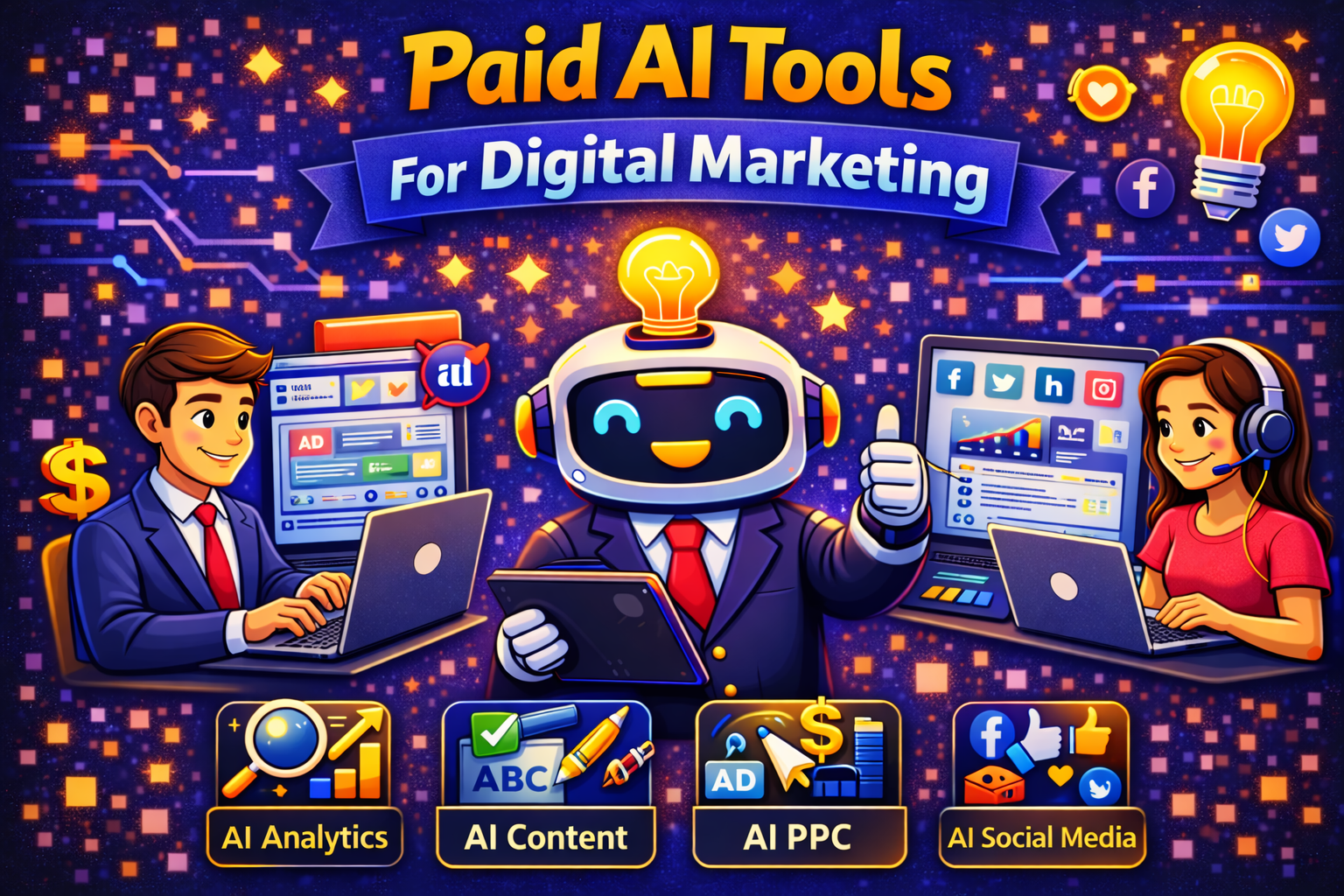
In an era where digital marketing evolves at the speed of data, artificial intelligence has transitioned from a speculative advantage to the operational backbone of successful campaigns. The landscape is saturated with point solutions claiming to leverage AI, but for marketing leaders and practitioners, the critical distinction lies in identifying and implementing paid AI tools that deliver measurable ROI—tools that move beyond generic automation to offer predictive intelligence, hyper-personalization, and strategic decision-making at scale.
This 3,000-word guide provides an original, in-depth analysis of the paid AI tool ecosystem, categorized not by generic function, but by the core marketing challenges they solve. We will explore the sophisticated capabilities that justify their investment, examine real-world application scenarios, and provide a strategic framework for integration that ensures these tools become force multipliers for your team.
Understanding the Paid AI Advantage in Marketing
Before evaluating specific tools, it’s essential to understand the value proposition of a premium, paid AI marketing platform versus free or basic automated tools. The investment unlocks:
- Predictive Analytics & Forecasting: Moving from describing what happened to predicting what will happen. This includes forecasting campaign performance, customer lifetime value (CLV), and churn risk.
- True Personalization at Scale: Dynamically tailoring content, offers, and journeys to individual users in real-time across channels, based on deep behavioral and intent data.
- Intelligent Automation of Complex Workflows: Automating not just scheduled posts, but multi-channel campaign orchestration, bid management, and creative optimization based on continuous performance feedback.
- Unified Data & Attribution Modeling: Silos are the enemy of insight. Paid tools break down barriers between channels, using AI to provide a unified view of the customer and sophisticated, algorithmic attribution.
- Advanced Creative Generation & Optimization: Using AI to generate and systematically test ad copy, imagery, and video variants to discover the highest-performing combinations.
- Enterprise-Grade Security, Compliance & Support: Ensuring marketing activities adhere to global data privacy regulations (GDPR, CCPA) with dedicated technical support and robust SLA guarantees.
Category 1: The Omnichannel Orchestration & Customer Data Platforms (CDPs)
These platforms serve as the central nervous system of AI-driven marketing, unifying customer data and activating it intelligently across every touchpoint.
1. Salesforce Marketing Cloud (with Einstein AI)
Salesforce has embedded its Einstein AI throughout the Marketing Cloud, transforming it from an email service provider to an intelligent journey orchestration engine.
- Advanced Capabilities:
- Einstein Engagement Scoring: Predicts how likely a customer is to engage with a specific message (email, ad) at a specific time, allowing for optimized send times and channel selection.
- Predictive Audiences: Automatically segments customers based on predicted behaviors, such as “likely to churn” or “high intent to purchase Product X,” enabling proactive campaign targeting.
- Journey Builder Optimization: Uses AI to analyze billions of customer journey data points to recommend the next best step for each individual, dynamically adjusting paths in real-time.
- Real-World Application: A retail brand uses Predictive Audiences to identify customers with a high likelihood of purchasing winter apparel. Einstein triggers a personalized, multi-touch journey: a dynamic display ad showcasing jackets viewed on-site, followed by an email with a tailored offer, and finally a personalized product carousel on the website homepage. All steps are coordinated, measured, and optimized by AI.
- Ideal For: Large enterprises already invested in the Salesforce ecosystem (Sales Cloud, Service Cloud) seeking a fully integrated, AI-powered marketing, sales, and service hub.
2. Adobe Experience Platform & Real-Time CDP
Adobe’s strength lies in its fusion of creative and data, powered by its Sensei AI framework.
- Advanced Capabilities:
- Real-Time Customer Profile: Unifies known and anonymous data (web, CRM, POS, call center) into a single, updatable profile that refreshes in milliseconds.
- AI-Driven Segmentation: Allows marketers to build complex segments using natural language (e.g., “Find users in California who watched over 50% of our product video but abandoned their cart in the last 3 days”).
- Offer Decisioning: An AI engine that selects the optimal offer, message, or experience for each customer profile in real-time, based on propensity models and business rules.
- Real-World Application: A media streaming service uses Real-Time CDP to combat churn. When a user exhibits micro-behaviors associated with cancellation (repeatedly browsing “Cancel Account” page, decreased viewing time), the AI triggers an intervention. This could be an in-app message offering a complimentary month of a premium tier or a personalized email with recommendations based on their unique viewing history, delivered within minutes of the risk signal.
- Ideal For: Brands with massive first-party data assets, particularly in B2C retail, travel, and media, where real-time personalization is a competitive necessity.
Category 2: Paid Media & Programmatic Advertising Intelligence
This category focuses on maximizing ROI across paid search, social, and display networks through autonomous optimization and predictive bidding.
1. Google Performance Max (with AI Core)
Performance Max is not just a tool; it’s a campaign type within Google Ads that represents a paradigm shift towards goal-based, fully automated media buying.
- Advanced Capabilities:
- Cross-Channel Autonomous Bidding: You provide assets (headlines, images, videos, descriptions) and a budget/conversion goal. Google’s AI then decides where, when, and to whom to show ads across its entire inventory (Search, YouTube, Display, Gmail, Discover, Maps) to achieve your goal.
- Dynamic Creative Optimization: The AI mixes and matches your provided assets in real-time to generate thousands of ad variants, testing them to find the perfect combination for each audience segment.
- New Customer Acquisition Modeling: Uses AI to find and target users who resemble your best existing customers, even if they haven’t yet interacted with your brand.
- Real-World Application: A local service business (e.g., plumbing) sets a goal for website lead form submissions. They upload a series of service photos, several ad copy options, and a short brand video. Performance Max AI then runs experiments, discovering that a specific image/copy combo works best on Google Search for “emergency plumber,” while the video drives high-quality leads on YouTube. It automatically allocates budget accordingly, all within a single campaign.
- Ideal For: Any advertiser using Google Ads, particularly small-to-midsize businesses or teams with limited bandwidth for manual campaign management across multiple channels.
2. Acquisio (by Cortex)
Acquisio is a sophisticated AI platform for managing and optimizing paid search and social campaigns, primarily for agencies and large-scale advertisers.
- Advanced Capabilities:
- Portfolio-Based AI Bidding: Instead of optimizing single keywords or ad groups, Acquisio’s AI analyzes performance across an entire account or portfolio of client accounts. It shifts budget strategically between campaigns and platforms (Google, Microsoft Advertising, Meta, LinkedIn) based on cross-channel performance trends.
- Predictive Budget Pacing: Forecasts daily performance and automatically adjusts bids and budgets to ensure monthly spending and conversion targets are hit evenly, avoiding end-of-month rushes or shortfalls.
- Creative & Landing Page Testing: Systematically tests ad copy and landing page elements, using AI to identify the drivers of performance and scale winning combinations.
- Real-World Application: A digital marketing agency manages 50+ local franchisee accounts for a national brand. Using Acquisio’s portfolio AI, they set a blended target Cost-Per-Lead (CPL) across all accounts. The AI automatically reduces spend on underperforming geographic campaigns in real-time and reallocates it to high-potential regions, while also testing localized ad copy variations for each franchisee, ensuring national brand consistency with local relevance.
- Ideal For: Marketing agencies and in-house teams managing large, complex portfolios of paid campaigns across multiple platforms who need centralized, AI-driven efficiency and scale.
Category 3: Content & Social Intelligence Platforms
These tools use AI to inform content strategy, create assets, and optimize social media engagement.
1. Concured (by seismic)
Concured focuses on the strategic side of content, using AI to analyze performance data and market trends to answer the critical question: “What should we create next?”
- Advanced Capabilities:
- Topic Propensity Engine: Analyzes your historical content performance, competitor content, and real-time search/social trends to predict which specific topics, angles, and formats will resonate with your audience and drive key metrics.
- Content Gap & Opportunity Analysis: Maps your content universe against competitor landscapes and search demand to visually identify white-space opportunities where you can establish authority.
- Personalized Content Hub: Can power dynamic content hubs on your website, where AI serves each visitor a personalized content feed based on their profile and intent, increasing engagement and time-on-site.
- Real-World Application: A B2B software company uses Concured to plan its quarterly content calendar. The AI recommends doubling down on “cloud security compliance” content after identifying a 200% surge in competitor engagement on the topic and a rising search trend. It suggests specific report formats and webinar angles, and later personalizes the published content for different segments (IT Directors vs. CTOs) on the resource center.
- Ideal For: Content marketing teams and strategists in competitive verticals who need to move from a gut-feeling editorial calendar to a data-driven content strategy.
2. Emplifi, Sprinklr & Khoros (Social Suite AI)
These enterprise social media management suites have deeply integrated AI for community management, customer care, and content optimization.
- Advanced Capabilities:
- AI-Powered Social Listening & Sentiment Analysis: Goes beyond keyword tracking to understand context, emotion, and urgency in brand mentions. Can detect PR crises in their infancy by spotting negative sentiment spikes.
- Optimal Send Time & Content Prediction: Analyzes individual follower behavior to determine the precise best time to post for maximum engagement for each person, rather than using a one-size-fits-all schedule.
- Automated Community Moderation & Routing: Uses natural language processing (NLP) to automatically categorize incoming messages (e.g., “sales inquiry,” “bug report,” “compliment”) and route them to the correct team or respond with pre-approved, intelligent answers.
- Real-World Application: A global telecommunications company uses Sprinklr’s AI to manage its social care. A customer tweets a frustrated, but vague, complaint about network speed. The AI classifies it as a “technical complaint – high urgency,” routes it instantly to the specialized social care team, and suggests a response template that includes a link to network status and a prompt to move to Direct Message for account-specific help—all within seconds.
- Ideal For: Large brands with massive social media presences and high volumes of customer interactions, where scaling personalized engagement and proactive reputation management is critical.
Category 4: SEO & Organic Search Intelligence
These platforms use AI to decode search engine algorithms, predict trends, and automate technical and content optimization.
1. MarketMuse
MarketMuse uses AI to model topic authority and plan content that systematically improves a website’s semantic understanding and search rankings for strategic keyword clusters.
- Advanced Capabilities:
- Topic Authority Modeling: Creates a knowledge graph of your subject area, scoring your content and your competitors’ on comprehensiveness and authority for hundreds of related subtopics.
- Strategic Content Briefs: Generates AI-driven briefs that don’t just list keywords, but prescribe the exact topics, questions, and concepts you must cover to build authority and rank, often recommending updates to existing content rather than new pieces.
- Optimization Scoring & Prioritization: Continuously audits your site, scoring each page and providing a prioritized roadmap for optimization based on potential traffic impact.
- Real-World Application: A financial advice website wants to rank for “retirement planning.” MarketMuse analyzes the top 20 results and reveals that authoritative pages comprehensively cover 12 core subtopics (e.g., “401(k) rollover rules,” “IRA contribution limits 2024,” “healthcare costs in retirement”). It scores the client’s existing page, finds it only deeply covers 5, and provides a detailed plan to expand the article to cover the 7 missing high-importance subtopics.
- Ideal For: Content-driven websites in expert fields (finance, health, law, B2B SaaS) where demonstrating topical authority to Google’s algorithms is paramount.
2. BrightEdge / Searchmetrics
These are enterprise SEO platforms that use AI for large-scale data processing, trend forecasting, and automated insights.
- Advanced Capabilities:
- AI-Generated “Insights”: Instead of just providing dashboards, the AI analyzes rank tracking, crawl, and search trend data to automatically surface actionable insights like, “Page X lost ranking due to an increase in page speed for the top 3 competitors,” or “There’s a rising 30-day trend for question-based searches around your product category.”
- Predictive Ranking Factors: Uses machine learning to determine which technical and content factors are most correlated with high rankings for your specific industry and keyword set, moving beyond generic SEO best practices.
- Automated Reporting & Alerting: Generates narrative-style performance reports and sends proactive alerts about ranking drops, indexation issues, or new ranking opportunities.
- Ideal For: Large organizations with complex, multinational websites where manual analysis is impossible, and SEO needs to be reported and executed as a data science discipline.
Strategic Integration Framework: Making AI Work for Your Marketing Team
Buying the tool is only step one. Successful implementation requires a strategic overhaul.
Phase 1: Foundation & Goal Alignment
- Audit Your Data: AI is only as good as its fuel. Clean, structured, and integrated first-party data (from your CRM, website, email) is a prerequisite.
- Define the “Job to be Done”: Don’t buy AI for AI’s sake. Start with a specific, high-value challenge: “Reduce paid media CPA by 15%,” “Increase email revenue per recipient by 20%,” “Cut content production time in half.”
- Assess Team Readiness: Prepare for a shift in roles. Marketers must evolve from manual executors to strategic directors and interpreters of AI. Invest in training.
Phase 2: Pilot & Prove Value
- Start with a Contained Pilot: Choose one tool for one specific campaign or channel. For example, run a Performance Max campaign alongside your traditional Search campaigns and compare results.
- Establish Clear KPIs & a Baseline: Measure the pilot against the current-state performance. Focus on efficiency (cost/time saved) AND effectiveness (improved conversion, engagement).
- Embrace the “Black Box” (Initially): Acknowledge that some AI (like Google’s bidding) is not fully transparent. Judge it purely on outcomes, not the process.
Phase 3: Scale & Synthesize
- Build Connected Workflows: Connect your AI tools. Let your SEO tool (MarketMuse) inform your content briefs, which are drafted with an AI writer, with performance data fed back into the CDP to personalize the content experience.
- Foster a Culture of Experimentation: AI provides a hypothesis (a predicted audience, a creative variant). The team’s role is to design rigorous tests, learn from outcomes, and refine the AI’s parameters.
- Focus on the Human+AI Hybrid: The future belongs to marketers who can ask the right strategic questions, interpret AI-driven insights with creative and ethical judgment, and oversee systems that execute with superhuman efficiency.
The Future: Autonomous Marketing Organizations
The trajectory is clear: from assisted to augmented to autonomous. The next generation of tools will feature:
- Self-Optimizing Campaigns: Campaigns that set their own budgets, create their own ad variants, and pivot strategy without human intervention.
- Predictive Customer Journey Synthesis: AI will not just optimize existing journeys but design entirely new, hyper-personalized journey blueprints for micro-segments of one.
- Real-Time Market Adaptation: Tools that ingest global news, social trends, and competitor movements to adjust brand messaging and campaign targeting in real-time.
Investing in the paid AI tools outlined here is not an expense; it is building the technological core of a modern marketing organization. By strategically selecting platforms that address your fundamental challenges—be it data unification, media efficiency, or content intelligence—you empower your team to compete on a new plane: where creativity is amplified by insight, and strategy is executed with machine precision and scale. The goal is not to replace the marketer, but to liberate them to do what only humans can do: dream, connect, and build enduring brands.